How to get kids to do chores without nagging
Nagging happens when you are the only reminder system in the house. Every “Have you fed the dog yet?” is you doing the remembering on your child’s behalf. Replacing it takes four parts working together: a list that does the reminding, a fixed time for each job, a when/then rule, and a single agreed cue you give once before falling silent.
Why repeating yourself backfires
Each reminder teaches a child that the real deadline is the third reminder, or the moment your voice changes. The AAP’s guidance on chores puts it plainly: badgering and scolding are not effective, while rewarding successes and encouragement work better. The goal is to make reminders unnecessary, not louder.
Notice too who carries the load. If the plan lives in your head, you have to keep announcing it. Once it lives on a wall or a screen, anyone can check it, and the conversation shifts from “Did you…?” to “What does the list say?”.
| The nag | What replaces it |
|---|---|
| “Have you fed the dog yet?” | The dog’s bowl is a line on the chart with a time beside it |
| “I’ve asked you three times!” | One agreed cue, said once |
| “If you don’t tidy up, no park.” | When the shoes are on the rack, then we go |
| “Why is this still here?” | A Sunday look at the week, not a running commentary |
A list that does the talking
A chore chart is, in the AAP’s words, a visual reminder. It only works if it is easy to see, complete and current. A list buried in a drawer is the same as no list.
- Put it where the jobs start: the kitchen for meal jobs, the hall for bins and shoes.
- One line per job with a time of day: “Before school: bag by the door”.
- Each child can see their own jobs without reading anyone else’s.
- Ticking is part of the job. Unticked jobs are unfinished jobs.
- Update it the same day a job changes, or the list loses its authority.
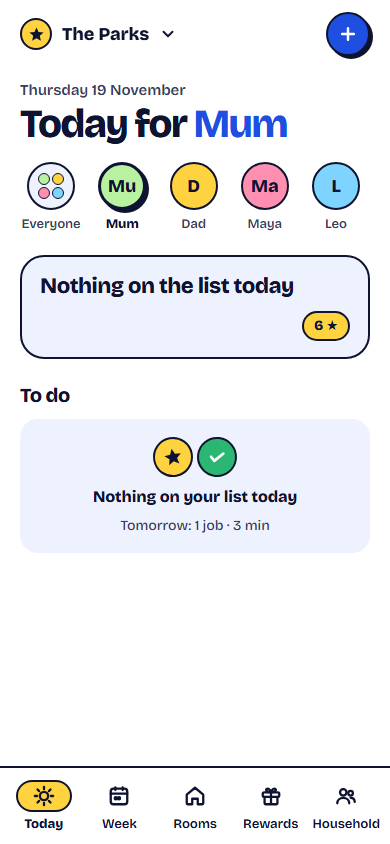
Paper is enough to begin: build a chart in the free chore chart maker, print it and stick it at eye level. In a sharechores household each person gets a Today list showing only their jobs for the day, and the printed fridge chart carries a QR code that opens Today for ticking, so a job done in the kitchen can be marked off right there.
The when/then rule
When/then links a job to something your child already wants next. It isn’t a bribe, because the next thing was going to happen anyway; it just comes after the job. It also turns you from enforcer into a simple gatekeeper of the order of events.
| When… | then… | Best for ages |
|---|---|---|
| your shoes are on the rack | we go to the park | 5–8 |
| the table is set | dinner comes out | 5–10 |
| your lunch box is in the sink | the tablet comes out | 7–12 |
| the bins are out | you’re free for the evening | 10–14 |
| your laundry is put away | we head to the cinema | 8–14 |
The CDC’s parenting advice is to say what you want to see rather than leading with “no”, “don’t” or “stop”. When/then does exactly that. Compare “No tablet until you’ve cleared up!” with “When the lunch box is in the sink, then the tablet comes out.” Same rule, no fight in the wording.
One cue, then silence
Agree with your kids in advance what the single reminder will be. After that cue you say nothing more about the job; the list and the when/then do the rest. It feels awkward the first week, because the silence is new. Hold it.
“Mia, chart check.” (Then nothing. If she asks what’s on it: “Have a look.”)
“Noah, it’s 5 o’clock.” “Kitchen’s open for jobs.” “Ten minutes till dinner – lists, please.”
Choose a cue that names the list, not the job. “Chart check” sends them to look; “Feed the dog!” makes you the list again. You could also tap the chart twice or ring a small bell instead of speaking at all.
If the cue passes and the job still sits, let the when/then work. The park waits. Dinner is served once the table is set. No speech needed, and no extra consequence either.
Same time, same place, every day
The AAP recommends doing chores at the same time each day so they become routine. A job with a fixed slot needs no announcement, because the slot itself is the reminder. Tie each job to an anchor: arriving home, the end of a meal, the moment before a screen goes on.
Yesterday’s leftovers need a plan too, or they become a fresh source of reminders. In a sharechores household an unfinished job from yesterday offers three choices: “Do it today”, “Pass it on” to someone else, or “Skip this time”. Deciding once beats bringing it up all evening.
Expect a test in the first week, when a child waits to see if the old reminders return. They will check whether silence really means silence. Once it does, the list usually carries on without you. If a job keeps failing, shrink it or move it, as described in chores for 7 to 9 year olds.
Questions people ask
Isn’t when/then just bribery?
No. A bribe is something extra offered to stop a refusal. When/then only orders things that were already going to happen, so the job comes first and the normal next activity follows.
What if my child ignores the cue completely?
Stay silent and let the “then” wait. The park, the screen or the free evening simply doesn’t start yet. Calm follow-through teaches more than a second reminder.
Does this work with teenagers?
Yes, with a more grown-up cue and a say in the timing. Agree the slot together and treat the cue as a courtesy rather than an order.
Should I take away privileges for undone chores?
The AAP lists removing privileges as a reasonable consequence and treats screens as privileges, not rights. Keep any consequence small, linked to the job and announced in advance.