How much allowance should a child get at each age?
There is no official allowance table, and any figure you read is just someone’s choice. What helps is a formula you can explain to your child, apply to every sibling and adjust as they grow. Here are three formulas, worked examples from six to fourteen, a guide to what the money should pay for, and clear moments to raise it.
Three formulas to start from
Each formula below is a practical starting point, not a norm. Pick the one that matches why you’re giving money at all, then plug in numbers that suit your budget.
| Formula | How it works | Suits families who… |
|---|---|---|
| Age-based | Child’s age × a base unit you choose, per week | Want something simple and automatically fair between siblings |
| Costs-based | Add up what the child will now pay for, plus a saving slice | Want the allowance to teach budgeting |
| Per star | An amount per star × the stars a full week earns | Link money directly to jobs done |
The age-based version needs only one decision: the base unit. With 50 cents per year of age, a seven-year-old gets $3.50 a week; with a full dollar, they get $7. Choose the unit by asking what feels right for your oldest child, then let the formula set everyone else.
| Age | 50¢ per year of age | $1 per year of age |
|---|---|---|
| 6 | $3.00 | $6 |
| 8 | $4.00 | $8 |
| 10 | $5.00 | $10 |
| 12 | $6.00 | $12 |
| 14 | $7.00 | $14 |
Worked examples from six to fourteen
Seeing the formulas applied makes the choice easier. These four children are imaginary; the arithmetic is the point.
- Sam, 6 (age-based, 50¢ unit): $3 a week. Covers nothing essential; it’s for learning to wait and choose, like saving three weeks for a toy car.
- Lily, 9 (per star): her daily jobs earn 4 stars, so a full week is 28. At 15¢ a star she can earn $4.20. A missed day costs her 60¢, which she notices without any lecture.
- Max, 12 (costs-based): he now pays for his own snacks after school ($5) and one outing with friends a fortnight ($5 a week averaged). Add $2 to save and he gets $12.
- Ruby, 14 (costs-based plus extras): she buys her own toiletries and phone top-up, about $15 a week, plus $3 to save: $18. Washing the car or weeding earns extra.
Notice that the older two cost more mainly because they pay for more. That’s what makes a costs-based allowance easy to defend when a younger sibling complains: “When you pay for your own snacks, yours will go up too.”
What the money should cover
An allowance that covers nothing teaches waiting. One that covers real spending teaches budgeting. Shift responsibility over gradually, one category at a time, so a mistake costs a week of treats rather than something essential.
| Age | Could cover | Keep paying yourself |
|---|---|---|
| 6–7 | Small treats, stickers, a toy saved for over weeks | Everything else |
| 8–9 | Treats, small toys, gifts for friends’ parties | Clothes, school costs, activities |
| 10–12 | Snacks out, games, cinema with friends | Clothing basics, school trips |
| 13–14 | Outings, toiletries, phone top-ups, some clothes | School needs, coats and shoes |
The CFPB’s guide to school-age children and earning says that, for a child’s development, the most important part of an allowance is talking with you about their plans for the money. A weekly two-minute chat about what they’re saving for does more than the exact amount.
Your allowance: $8 every Sunday It pays for: treats, small toys, party gifts We still pay for: clothes, school, swimming Saving goal: ______________ (cost: $____) Next review: your birthday
When to raise it, and how
Raise the allowance at predictable moments, never because of a good negotiation in the car. Predictability keeps it from becoming a weekly bargaining session and makes the rule the same for every sibling.
Avoid raising it to stop complaints after comparisons with friends. The CFPB suggests being ready to discuss your own family’s situation when kids compare. A calm script helps:
“Every family decides this differently. Ours is worked out from your age and what you pay for. When you start buying your own lunches out, it goes up. Want to look at that list together?”
Keeping a record without a spreadsheet
A per-star or per-chore allowance needs a tally, and a tally needs to be trusted by both sides. Write the week’s total and the date paid in a notebook, or let an app keep the record.
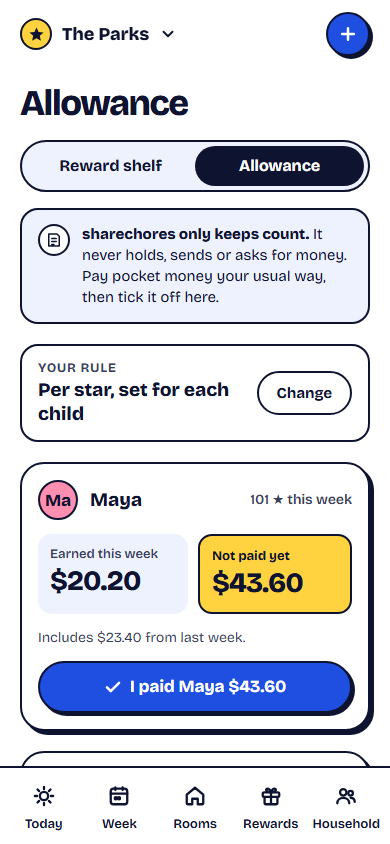
With the sharechores paid plan, you set an amount per star or per chore for each child. It shows what’s been earned this week and keeps a record of the payouts you mark as paid, so “Did you pay me last week?” has an answer. It never holds or sends money; you hand over the cash or transfer it yourself. To try the job list first, the free chore chart maker prints a week to tick by hand.
If you’re still deciding whether money is the right motivator at all, points, allowance or rewards compares the options by age and goal.
Questions people ask
Is there a standard allowance amount by age?
No official standard exists. Use a formula, such as a base unit per year of age, and set the unit to suit your budget and what the money covers.
Should allowance be tied to chores?
Either works. Tying it to stars links effort and pay; a flat amount with a separate paid extras list keeps everyday jobs as part of family life.
Weekly or monthly?
Weekly for under-tens, since a month is a long wait at that age. From about twelve, monthly payments add a real budgeting challenge.
What if my child spends it all at once?
Let them, and don’t top it up. Running out on Tuesday is an inexpensive lesson. Talk about it at the next payday, not in the shop.