Reward ideas for chores that aren’t screens or sweets
Screen minutes and sweets are the easy rewards, which is exactly why they wear out. The ones that last cost little and mean a lot: an hour of your undivided attention, choosing dinner, a later bedtime on Saturday, a trip to the climbing wall. Below are four kinds of reward, ideas for each age, star costs to start from, and a way to let kids ask for them without nagging you.
Four kinds of reward worth saving for
Most non-screen, non-sugar rewards fall into four groups. A good menu has something from each, so a child who doesn’t care for outings still has something to work toward.
| Type | Examples | Why kids value it |
|---|---|---|
| Time with you | A board game, a bike ride, baking together | Your full attention, with no siblings around |
| Privileges | Later bedtime, front seat, a friend to stay over | A taste of being older |
| Experiences | Swimming, a museum, a picnic of their choosing | Something to look forward to and talk about |
| Choices | Pick dinner, the weekend film, Saturday’s plan | Control over something that affects everyone |
The CDC’s tips on praise and rewards single out extra time with you, or a special activity together, as a powerful reward. It’s also the cheapest item on the menu and the one children remember.
Ideas by age, with star costs
Star costs below assume a child earns roughly three to five stars a day from everyday jobs. Treat them as starting values to tune: if a reward is never claimed, it’s too dear; if it’s claimed every day, it’s too cheap.
| Age | Small (5–10 stars) | Medium (15–25 stars) | Big (40–60 stars) |
|---|---|---|---|
| 5–6 | Choose the bedtime story, an extra song at bath time | Bake cookies with a grown-up, pick the park | A trip to the farm or aquarium |
| 7–9 | Front seat for a day, choose a side dish | Pick the family film, a bike ride with you | A friend over for the afternoon |
| 10–12 | Skip one job of their choice, 20 minutes later bedtime | Choose dinner and help cook it, a café trip with you | A sleepover, a climbing-wall session |
| 13–14 | A lie-in with no morning jobs on Saturday | Plan the family day out | A concert or match ticket shared with you |
Pricing rewards so they stay worth it
The AAP’s guide to rewards as positive reinforcement recommends small rewards for a preset number of points earned daily or weekly, larger ones for longer stretches, and rewards the child helps choose. Children should know exactly how many points each one takes.
- Have at least one reward a child can reach in a single good day.
- Have one that takes about a week, so effort adds up to something visible.
- Keep one big goal on the menu that takes three or four weeks.
- Let your child suggest two items per menu; veto only what you can’t afford or allow.
- Change one item each month so the menu doesn’t go stale.
- Never raise a price after a child has started saving for it.
Ask what they’d like before you price anything. A seven-year-old may value choosing breakfast cereal more than a trip you’d expect them to love. The menu works best when it reflects their wishes, not your guesses. Brothers and sisters can have different menus; what matters is that each child finds at least three things on theirs worth working for.
Giving the reward well
How you hand over a reward matters nearly as much as what it is. The CDC advises giving it straight after the behaviour where possible and naming what earned it. For bigger rewards that can’t happen immediately, set the date the moment it’s claimed.
“You’ve saved 20 stars from setting the table every night. That’s the film pick! What are we watching on Friday, Zoe?” “Forty stars, Finn. The climbing wall is booked for Sunday morning, just you and me.”
Keep stars that have been earned. The AAP warns against penalties and demerits on reward charts; taking stars away for unrelated behaviour turns a motivating tally into a source of resentment.
Letting kids ask without asking you every hour
A posted menu stops the “Can I have…?” questions, because the answer is on the wall: enough stars, yes; not yet, keep going. Pair it with a regular moment to cash in, like Friday after dinner, so claiming rewards doesn’t interrupt every evening.
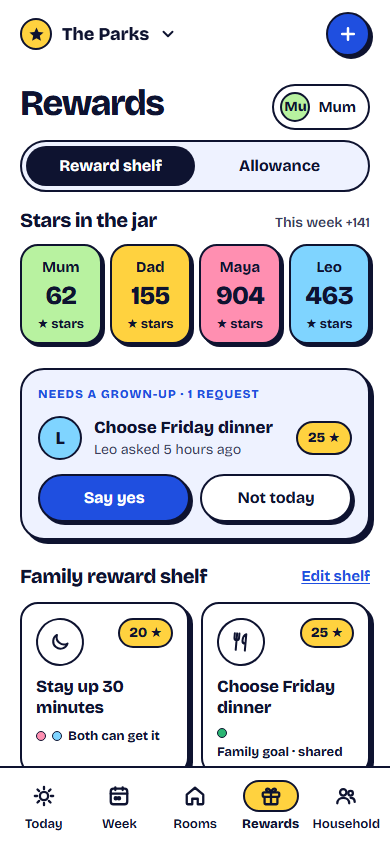
A sharechores paid plan adds a rewards list you set up yourself, each with an emoji and a star cost, available to everyone or just the kids you pick. A child requests one, and it lands with a grown-up to approve or decline, optionally with a note such as “Saturday after swimming”. In the kids view, a star trail shows how close they are to their next gold sticker, which keeps saving visible. The free chart maker is enough to start a printed star chart with the menu taped beside it.
Still deciding between rewards, money and plain stars? Points, allowance or rewards for chores sets out which fits each age.
Questions people ask
What are good rewards for kids that aren’t screen time?
Time with you, small privileges like a later bedtime, outings such as swimming, and choices like picking dinner. Let your child add a couple of their own ideas.
How many stars should a reward cost?
Price small rewards at about a day’s stars, medium ones at a week’s and big ones at three or four weeks’. Adjust if nobody claims a reward or everyone claims it daily.
Is a later bedtime a good reward?
For occasional use, yes. Keep it to weekends or one night, and keep the extra time short, so sleep routines stay intact.
Should siblings share rewards?
Shared rewards like a family film can pool stars from everyone. Keep personal rewards separate, so one child’s effort doesn’t pay for another’s treat.