What chores can a 5- or 6-year-old really do?
Five- and six-year-olds want to be useful, provided the job is short, concrete and clearly theirs. Below you’ll find a starter list sized for small hands, a way to show jobs to a child who can’t read yet, realistic minutes for each task, and a slow rollout that protects the early enthusiasm instead of burning it in a week.
A starter list sized for small hands
The American Academy of Pediatrics’ list of age-appropriate chores puts a surprising amount within reach of the 5–7 group: tidying toys, getting dirty clothes into the hamper, setting and clearing the table, feeding a pet, emptying wastebaskets, watering flowers and bringing in the mail all appear there. The trick at this age is choosing the versions that finish quickly and look obviously done.
| Job | What “finished” looks like | Rough minutes |
|---|---|---|
| Toys back in their bins | You can walk across the floor without stepping on anything | 5 |
| Clothes into the hamper | Nothing worn today is left on the bedroom floor | 2 |
| Forks and spoons on the table | One of each at every seat | 3 |
| Own plate to the counter | Plate beside the sink, scraps in the bin | 1 |
| Pet’s food bowl | One pre-measured scoop in the bowl | 2 |
| Small wastebaskets | Bedroom and bathroom bins tipped into the big one | 4 |
| Water the plants | Soil looks dark and damp, no puddle on the sill | 3 |
| Bring in the post | Letters left on the hall table | 2 |
| Pair clean socks | Pairs folded together, odd ones in a little heap | 5 |
Dusting low shelves, sorting laundry by colour, sweeping with a small broom and washing plastic dishes are on the same list. Keep those in reserve until the first two or three jobs run smoothly; they make good “promotions” later.
Showing jobs to a child who can’t read yet
Most kids at five read a few words at best, so the list has to speak in pictures. If they need you to read it out, the list becomes another way of reminding them, and the point is that they can check it alone.
- Take a photo of your child doing each job and print it small. Kids recognise themselves instantly.
- Or draw a stick-figure symbol beside each line: a bin, a sock, a fork, a watering can.
- Give each child one colour so siblings never confuse whose row is whose.
- Hang it at their eye height, not yours. The fridge door or the back of the bedroom door both work.
- Keep the order identical every day, so the third picture is always the plants.
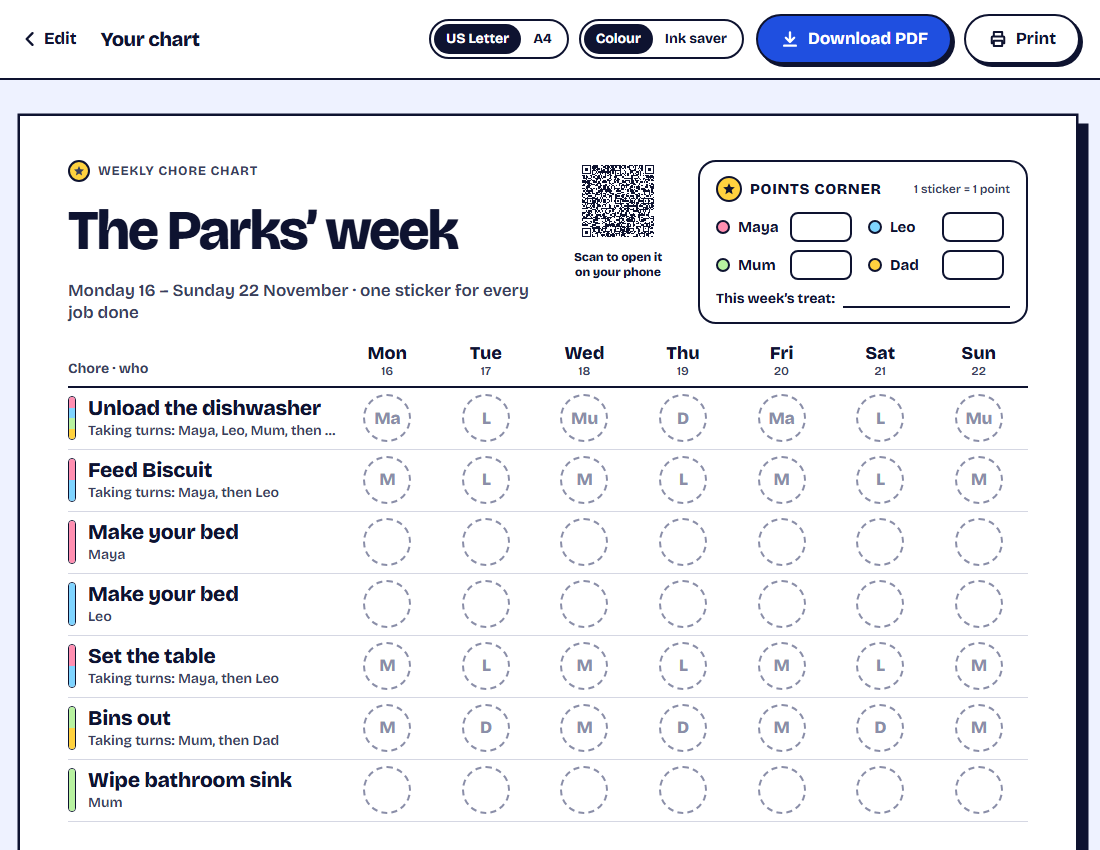
The free chore chart maker prints a clean chart from the jobs you tap in, with no account needed. For a non-reader, print it and add a doodle or a sticker next to each line before it goes up.
🧸 Toys in the bins 👕 Clothes in the hamper 🍴 Forks and spoons out 🐱 Cat’s scoop in the bowl 🌱 Water the plants
Add one job, then wait
The pediatricians’ advice for a school-age child who is new to chores is to introduce one task at a time, because a long list can overwhelm. In practice that means you start with a single job and add the next only once the first happens most days without a fight.
| Week | New job | Already doing |
|---|---|---|
| 1 | Clothes into the hamper at bath time | Nothing yet |
| 2 | Own plate to the counter after dinner | Hamper |
| 3 | Toys into bins before the bedtime story | Hamper, plate |
| 4 | Forks and spoons out for dinner | Hamper, plate, toys |
| 5 | Pet’s food bowl, or the plants | The four above |
Teach each new job by doing it side by side two or three times, then let them try while you stay close, then step back. If week three wobbles, stay on week three. There is no prize for reaching week five on schedule.
Once this set feels easy, usually somewhere around seven, the next stage is a list they read and tick for themselves.
How many minutes, and when
A sensible ceiling for this age is about ten to fifteen minutes of jobs spread across the day, not one long block. Small children run out of focus quickly, and a job that drags turns into a job they dread.
Pin each task to something that already happens. The AAP suggests doing chores at the same time each day so they become part of the routine, and routines are what spare you from announcing every job out loud.
| Anchor moment | Job that fits | Why it works |
|---|---|---|
| After breakfast | Plate to the counter | The plate is already in their hands |
| Home from school | Bring in the post | They pass the letterbox anyway |
| Before dinner | Forks and spoons out | Hungry kids move quickly |
| Bath time | Clothes into the hamper | They are taking the clothes off right there |
| Before the story | Toys into bins | The story is the natural finish line |
What to say while they’re learning
Expect wonky forks and a half-full bin. The AAP is clear that you should praise effort rather than outcome and avoid expecting perfection. Redoing a job in front of your child tells them the work didn’t count; if something really needs fixing, fix it later and quietly.
“You remembered the hamper all by yourself.” “Look, every seat has a fork now. Thank you, Ruby.” “That was tricky and you kept going.” “Plants first or post first? You choose.”
Stickers suit this age well, and a sticker straight after the job lands better than a promise of something at the weekend. Keep the reward small and the praise specific.
Questions people ask
Is five too young for chores?
No. The AAP’s list starts at age five with jobs like putting toys away and filling a pet’s dish. Keep each task short and specific and five is a fine age to begin.
How many chores should a 6-year-old have?
Three to five small daily jobs is plenty once they are settled, adding up to roughly ten or fifteen minutes. Begin with one and add more only as each sticks.
Should I pay a 5-year-old for chores?
Money means little at five. Stickers, a star on the chart and your attention work better here. Points or pocket money can come later, once numbers mean something to them.
What if my child does the job badly?
Thank them for doing it, show the next step once, and let the rest go. Speed and neatness arrive with practice, not correction.