The 15-minute weekly family meeting: an agenda that actually works
A short family meeting once a week replaces dozens of reminders and hallway negotiations. Here’s an agenda timed to fifteen minutes, who runs it, how kids take part, words for each part, and what to bring so the meeting runs on facts rather than one parent’s memory.
Why weekly, and why so short
A lot of household friction comes from things nobody raised until they became a problem: a job that’s been slipping, a busy week nobody planned for, a swap that was never agreed. A weekly meeting gives those a home. Kept to fifteen minutes, it stays something people will turn up for, not a lecture to dread.
- Same time every week. Sunday after dinner suits many families, because the week ahead is fresh.
- Everyone who lives there. Adults, plus kids old enough to sit for fifteen minutes — roughly five and up.
- A timer on the table. When it rings, you stop, even mid-topic.
- Nothing heavy. Serious adult conversations happen separately.
If the adults haven’t agreed their own split yet, settle that first on your own — how to split chores fairly with a partner walks through it — so the family meeting adjusts a plan instead of negotiating one in front of the kids.
The agenda, minute by minute
| Minutes | Part | What happens |
|---|---|---|
| 0–2 | Thanks | Each person names one thing someone else did this week |
| 2–5 | Last week | Look at the chore chart: what went well, what slipped |
| 5–9 | Next week | Busy days, late nights, visitors; adjust who does what |
| 9–12 | One problem | A single issue, solved together, one change agreed |
| 12–14 | Turns and swaps | Confirm who has which job and whose turn is next |
| 14–15 | Something good | A treat, a weekend plan, or choosing next week’s chair |
Write the agenda once and stick it beside the chart, so nobody has to carry it in their head.
FAMILY MEETING — 15 minutes 1. Thanks (2 min) 2. Last week (3 min) 3. Next week (4 min) 4. One problem (3 min) 5. Turns and swaps (2 min) 6. Something good (1 min)
Who runs it
If the same adult always runs the meeting, it quietly becomes one more job for the person who already holds the household together. Rotate it.
- The chair keeps time, reads out the agenda and moves things along. Kids from about eight can do this with the printed agenda in front of them.
- The note-taker writes down changes: new owners, swaps, the fix you agreed. Ideally a different person from the chair.
- Adults alternate weeks. Both should chair as often as each other, so neither becomes the household’s meeting manager.
- Changes go on the chart straight away, done by the note-taker before anyone leaves the table.
If one of you is the default contact for every question at home, a rotating chair is a small, visible way to share that role. Being the default parent covers the rest of that shift.
What kids do in the meeting
Children aren’t there just to be handed chores; they’re there to have a say in them. Keep their part concrete:
| Age | They can |
|---|---|
| 5–7 | Say a thank-you, choose between two jobs, pick the treat |
| 8–10 | Chair the meeting, read out the chart, suggest a swap |
| 11–14 | Raise a problem, propose a fix, take notes, plan around their own busy days |
Words for each part
Okay, timer’s on — fifteen minutes. Thanks first. Who wants to start?
Here’s this week’s chart. What went well? Was there a job that kept getting missed — and is that the job itself or the timing?
Today’s one problem is the shoes piling up by the door. What could we change? Let’s choose one idea and try it until next Sunday.
We’re at fifteen minutes. Let’s park that and put it first next week.
The problem slot is the most valuable three minutes. Take one issue, gather ideas from everyone, choose one to try for a week, and add it to next week’s agenda to see if it worked. One small change each week adds up faster than a big reset once a year.
When the meeting goes off track
| Snag | Try this |
|---|---|
| It turns into a telling-off | Keep thanks first and limit the problem slot to one issue, framed as “what could we change?” |
| It keeps running long | Trust the timer; park leftovers for next week, first on the list |
| The same adult ends up chairing | Write the chair for the next four weeks on the agenda sheet |
| Agreed changes vanish by Tuesday | Update the chart before anyone leaves the table |
| A week gets skipped | Hold a five-minute version standing in the kitchen rather than dropping it |
Bring the chart, not your memory
The meeting works best with something everyone can look at. A printed week from the free chart maker, ticked through the week, is enough to start.
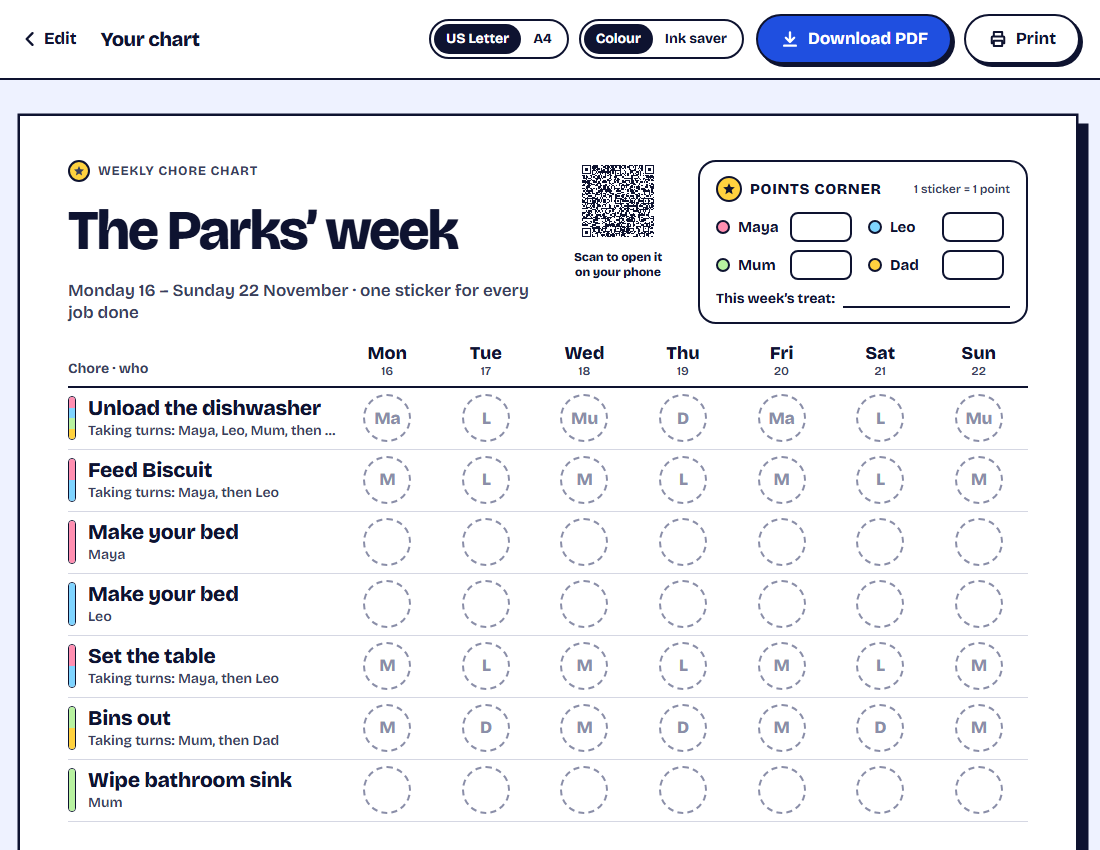
With sharechores, bring the weekly who-did-what count — how many chores each person finished — and use it to open “what went well, what slipped”, never as a ranking. Owners and turns can be changed right there at the table, and you can print the coming week’s chart with everyone’s jobs already filled in. On a paid plan, a summary email arrives each Sunday with the week at a glance, handy to skim before you sit down.
Questions people ask
How long should a weekly family meeting be?
Fifteen minutes is plenty. Use a timer, cover the same six parts each week, and move anything bigger to a separate adults-only conversation.
What age can kids join a family meeting?
From about five, for the thanks and choosing between jobs. From around eight they can chair with a printed agenda; older kids can raise problems and take notes.
What if someone doesn’t want to come?
Keep it short, start with thanks, end with something good, and let everyone bring a problem — including ones about the adults. Meetings that only hand out jobs lose people quickly.
Should we talk about money or big decisions?
Not in the weekly family meeting. Keep it to the week ahead, chores and one small problem; bigger adult topics need their own time.