Hand off ownership, not tasks: how to give away a whole household job
Handing over a task gets one thing done. Handing over a job means you never have to think about it again. This guide shows you how to choose the first job to give away, run a proper handover, and hold a hands-off period long enough for the new owner to make it theirs.
A task is one step; a job has four
Every household job runs in a loop: someone notices it’s needed, plans how it’ll happen, does it, and follows up. When only the middle step moves to another adult, the loop still starts and ends with you.
| Stage | Task handed off | Job handed off |
|---|---|---|
| Notice | You see the kids need new shoes | Your partner keeps an eye on fit and wear |
| Plan | You pick the shop and the day | They decide when and where |
| Do | Your partner takes them shopping | They take them, or arrange it |
| Follow up | You check the size and keep the receipt | They handle returns, and the next pair |
Only the right-hand column lightens your head. It asks more of the new owner at first, which is why it deserves a real handover rather than a passing “can you take over shoes?” in the hallway.
Choose the first job to give away
Start with one job that has clear edges, comes round often enough to learn quickly, and won’t cause a crisis if it wobbles for a week.
| Job | As a first handover |
|---|---|
| The weekly shop and the shopping list | Easy: regular, and it’s obvious when it’s done |
| Laundry from basket to drawer | Easy: clear start and finish, low stakes if late |
| Bins and recycling | Easy: fixed days make the noticing simple |
| Pet care | Easy: a daily rhythm and quick feedback |
| Kids’ health appointments | Harder: long gaps between visits and real deadlines; hand it over second or third |
| School admin | Harder: lots of small dates; worth it once handovers are a habit |
If you’ve already worked through the mental load checklist, pick from the lines marked as yours that the other adult said they’d actually prefer. Preference makes the first handover stick.
The handover checklist
A good handover passes on everything that currently lives only in your head. Sit down for twenty to thirty minutes and go through this together. The new owner writes the notes, not you, so the knowledge lands with them.
The handover conversation
I’d like to fully hand you the weekly shop — the list, the planning and the buying, not just the trip. Can we sit for half an hour on Sunday so I can tell you everything that’s in my head about it? After that I’ll step right back.
That’s everything I know. From Monday it’s yours to run your way. I won’t remind you and I won’t redo it. Let’s look at how it’s going together in three weeks.
Keep the tone practical. You’re passing on knowledge between equals, not training an apprentice. Some of your methods are genuinely better; some are just habits. Say which is which, and let the habits go.
Hold a hands-off period
The handover isn’t finished until the new owner has run the job several times without you. Agree a hands-off period — three to four weeks for a weekly job, longer for a monthly one — and keep these rules during it:
- No reminders from you. If the job needs a prompt, the prompt belongs to the owner: their phone, the fridge chart, a set day.
- No silent rescues. Redoing it, finishing it or topping up what ran out pulls the job straight back.
- Send questions to the owner. If a child asks you about something in that area, point them to the new owner.
- One standard, said once. If something truly matters — an allergy, a deadline with a fee — say it in the handover, not halfway through.
- Save comments for the check-in. Jot down anything that bothers you and bring it to the agreed date.
Expect a wobble around the second or third round. That’s when the new owner runs into the bits you never mentioned. Answer the question they ask, and resist taking the job back.
The check-in, and the next handover
- What went well, from the owner’s side?
- What surprised them about the job?
- Is anything still routed through you that should move?
- Does the written description of the job need updating?
- Is it time to pick the next handover?
Once one job has properly moved, the second is easier, because you both know what a handover looks like. One new handover a month is a steady pace until the split feels fair to both of you.
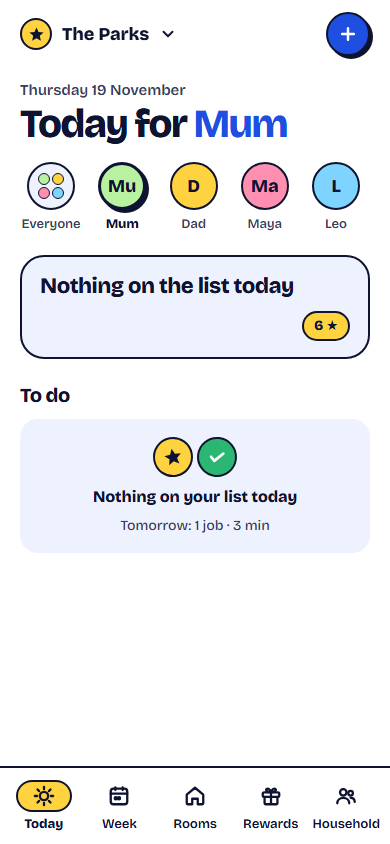
For the repeating parts of each job, a shared and visible list becomes the new owner’s memory. Put them on the free chart maker, or set them up in sharechores as that person’s chore: it shows on their Today list on the right days, and they tick it off from their own phone. Nobody has to pass a message on, because the job turns up for its owner. If a handover stalls, the words in what to say instead of “I shouldn’t have to ask” can help restart it.
Questions people ask
What’s the difference between delegating and handing off?
Delegating usually passes one task while you keep planning and checking. Handing off passes the whole job — noticing, planning, doing and following up — so it leaves your head completely.
How long should the hands-off period be?
Long enough for the job to come round three or four times: three to four weeks for a weekly job, a couple of months for a monthly one.
What if they do it differently from me?
Different is fine if the outcome works. Name the one or two standards that truly matter during the handover, and let the rest be done their way.
What if the job keeps slipping?
Look at the setup first: can the owner see the schedule, have outside contacts been updated, is the job too big for one step? Fix that at the check-in before deciding someone else should own it.